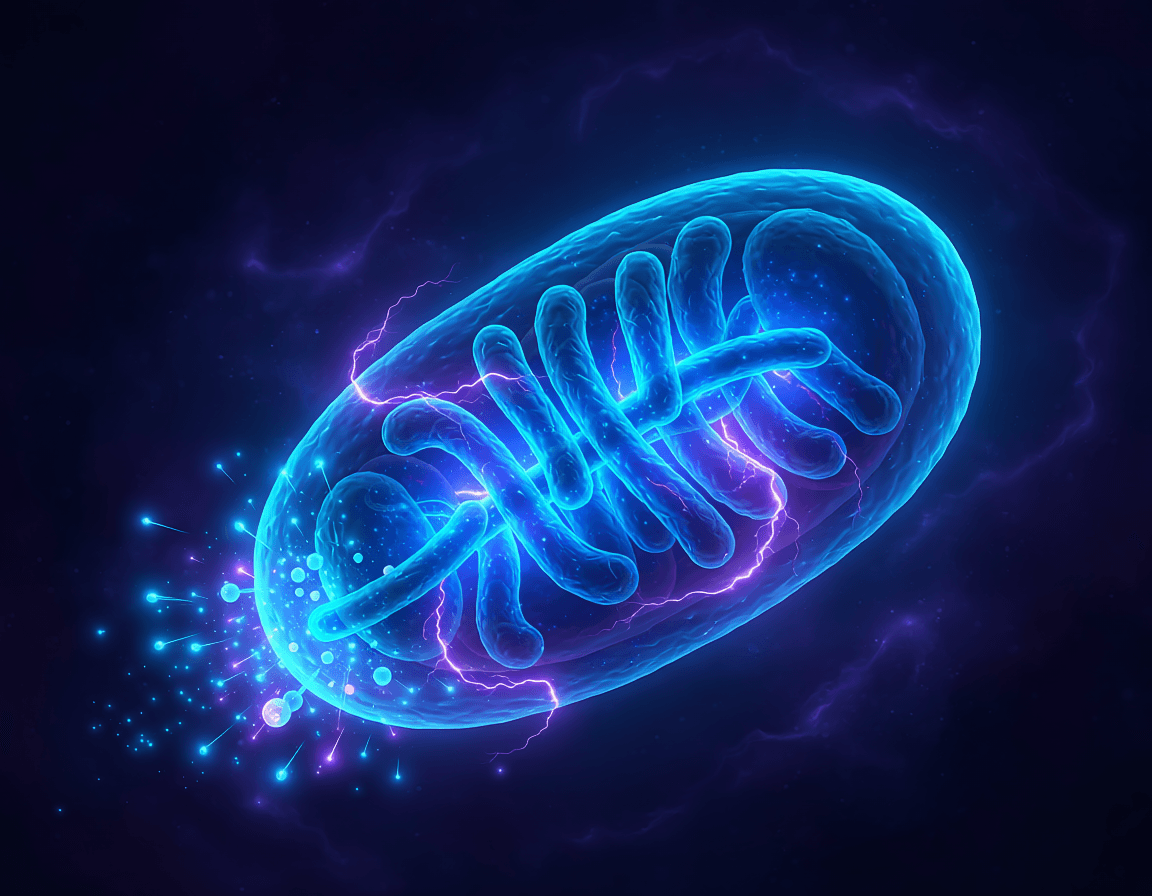
Every cell in your body runs on a molecular currency called ATP. But ATP cannot be manufactured without a helper molecule — nicotinamide adenine dinucleotide, better known as NAD+. It shuttles electrons through the mitochondrial respiratory chain, powers DNA repair enzymes, and activates a class of longevity-linked proteins called sirtuins. Without adequate NAD+, cellular machinery slows, errors accumulate, and the hallmarks of biological ageing accelerate.
The decline problem
NAD+ levels fall substantially with age. Studies in human tissue consistently show a 40–50% reduction between the ages of 20 and 50, and a further decline thereafter. This is not trivial. A 60-year-old may be operating with less than half the NAD+ capacity of a young adult — at the level of every cell, across every organ system.
The reasons for this decline are multifactorial:
- Reduced biosynthesis — the salvage pathway enzyme NAMPT, which recycles nicotinamide into NAD+, becomes less active with age
- Increased consumption — PARP enzymes (DNA repair) and CD38 (immune signalling) consume NAD+ at accelerating rates as age-related DNA damage accumulates
- Reduced precursor availability — dietary tryptophan and nicotinamide conversion efficiency decreases
Approximate NAD+ decline by decade
| Age range | Estimated NAD+ level | Key functional impact |
|---|---|---|
| 20–30 | 100% (baseline) | Peak mitochondrial efficiency, rapid DNA repair |
| 40–50 | 55–65% | Perceptible fatigue onset, early metabolic shifts |
| 60–70 | 30–45% | Reduced muscle recovery, cognitive performance changes |
| 70+ | 15–30% | Significant mitochondrial dysfunction in multiple tissues |
The sirtuin connection
Sirtuins (SIRT1–7) are a family of NAD+-dependent enzymes that regulate some of the most fundamental biological processes: gene expression, metabolic adaptation, DNA repair, and stress resistance. They are sometimes called "longevity genes" because of their striking effects in model organisms — yeast with elevated sirtuin activity live up to 70% longer; worms and mice show similar extensions.
The critical detail: sirtuins cannot function without NAD+. They consume it as a substrate during deacetylation reactions. When NAD+ falls, sirtuins are silenced. This creates a self-amplifying cycle — less NAD+ means less sirtuin activity, which means worse metabolic regulation and faster cellular ageing.
NAD+ precursors in research
Direct intravenous NAD+ administration is used clinically in some wellness contexts, but research has also extensively studied precursor molecules that the body converts into NAD+:
NMN (Nicotinamide Mononucleotide) — enters cells via the Slc12a8 transporter, rapidly converted to NAD+ in most tissues. A 2021 Washington University study (Yoshino et al., Science) demonstrated that 250 mg/day NMN in prediabetic women improved muscle insulin sensitivity and gene expression linked to muscle remodelling.
NR (Nicotinamide Riboside) — converted to NMN and then NAD+. Multiple human trials have demonstrated NAD+ elevation in blood within 2–4 weeks of supplementation. ChromaDex-sponsored trials and independent replications from multiple institutions confirm the pharmacokinetics.
Nicotinamide (NAM) — the simplest precursor, also most readily available from diet. At high doses it paradoxically inhibits sirtuins, so research protocols typically prefer NMN or NR.
NAD+ precursors compared in human research
| Precursor | Conversion steps | Evidence level | Notes |
|---|---|---|---|
| NMN | 1 step (→ NAD+) | Multiple human trials | IV and oral forms studied |
| NR | 2 steps (→ NMN → NAD+) | Strongest human RCT dataset | Well-tolerated at 1–2 g/day |
| NAM | Multiple steps | Broad dietary evidence | Sirtuin inhibition at high dose |
| Tryptophan | ~8 enzymatic steps | Dietary only | De novo synthesis pathway |
PARP, CD38, and the NAD+ sink problem
Two enzymes deserve special mention because they may contribute as much to age-related NAD+ depletion as reduced synthesis:
PARP1 (poly-ADP-ribose polymerase 1) is the primary DNA repair enzyme in the nucleus. Each repair event consumes multiple NAD+ molecules. As cumulative DNA damage increases with age — from UV exposure, reactive oxygen species, replication errors — PARP1 becomes chronically activated, draining the NAD+ pool faster than biosynthesis can replenish it.
CD38 is a cell surface enzyme that degrades NAD+ as part of calcium signalling. CD38 expression increases markedly with age-related inflammation ("inflammaging"). Research has shown that CD38 inhibitors raise tissue NAD+ levels in mice substantially, even without increasing precursor supply.
What the human data show
Several randomised controlled trials have now been completed. Key findings:
- Yoshino et al. (Science, 2021): 250 mg/day NMN for 10 weeks improved muscle insulin sensitivity in postmenopausal prediabetic women; skeletal muscle NAD+ metabolome was significantly altered
- Elhassan et al. (Cell Rep, 2019): NR 1g/day for 21 days elevated whole blood NAD+ by 2.3× in healthy older adults; no serious adverse events
- Dellinger et al. (Nat Aging, 2023): 900 mg/day NMN for 60 days elevated blood NAD+ by 38% in 30–79-year-olds and improved gait speed — a validated biomarker of biological ageing
- Irie et al. (NPJ Aging, 2020): NMN improved sleep quality and muscle strength in 65–80-year-old men at 250 mg/day
None of these trials show dramatic anti-ageing outcomes, and effect sizes remain modest. What the cumulative data do confirm is that oral NAD+ precursors reliably raise tissue NAD+ in humans, and that this elevation is associated with measurable improvements in metabolic and functional markers in older adults.
Laboratory sourcing and storage
Research-grade NAD+, NMN, and NR should meet the following standards:
- Identity: confirmed by NMR or HPLC-MS with reference to pharmacopoeial standard
- Purity: ≥98% for most research applications; ≥99% for cell culture or sensitive assays
- Moisture control: all three compounds are hygroscopic; store desiccated at −20 °C
- Endotoxin: <1 EU/mg for any assay involving immune-competent cells or in vivo use
- Lot traceability: CoA with synthesis date, analytical data, and storage history